Executive résumé example

Executive résumé example with a free Word template.

A complete two-page résumé for a chief operating officer, the same résumé rewritten for a COO posting by OneResume, and the skills current executive postings ask for. Download the Word file and make it yours.

  • Free .docx template
  • A tailored version, side by side
  • Skills from 82 current postings
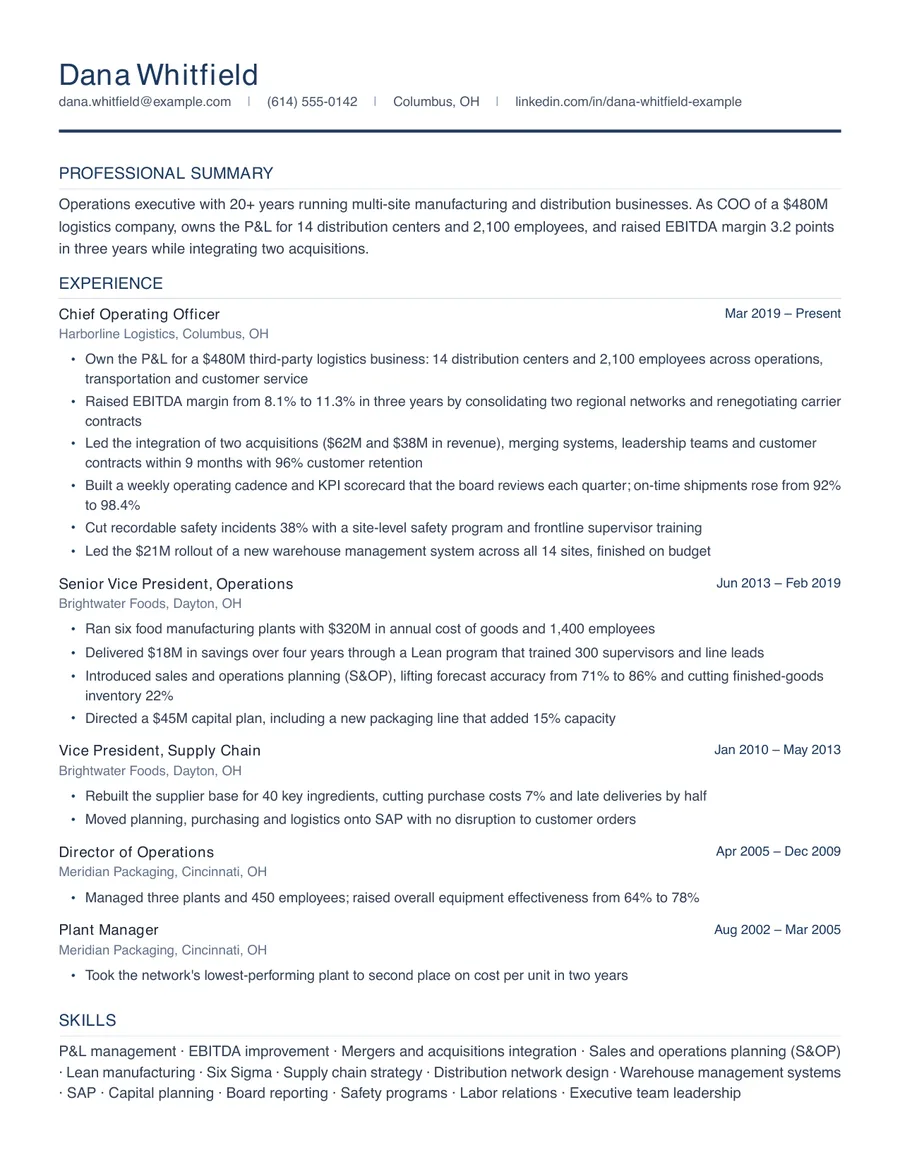
Page one of Dana Whitfield's sample résumé in the Professional template

The sample

Dana Whitfield

Chief Operating Officer, 20+ years in manufacturing and distribution

A fictional person and fictional employers, written as a real résumé. Shown in the Professional template.

The full executive résumé

Dana Whitfield is a fictional chief operating officer: twenty years from plant manager to the top operations job at a $480M logistics company, with two acquisitions and a warehouse-system rollout along the way. Her résumé is the kind a search partner forwards to a CEO without rewriting it.

Read it for the shape as much as the words. It runs to two pages. The two most recent roles carry almost all of the detail, the plant manager years shrink to one line, and there isn't a graduation year in sight.

Dana Whitfield

Columbus, OH · dana.whitfield@example.com · (614) 555-0142 · linkedin.com/in/dana-whitfield-example

Summary

Operations executive with 20+ years running multi-site manufacturing and distribution businesses. As COO of a $480M logistics company, owns the P&L for 14 distribution centers and 2,100 employees, and raised EBITDA margin 3.2 points in three years while integrating two acquisitions.

Experience

Chief Operating Officer, Harborline Logistics

Mar 2019 – Present

Columbus, OH

  • Own the P&L for a $480M third-party logistics business: 14 distribution centers and 2,100 employees across operations, transportation and customer service
  • Raised EBITDA margin from 8.1% to 11.3% in three years by consolidating two regional networks and renegotiating carrier contracts
  • Led the integration of two acquisitions ($62M and $38M in revenue), merging systems, leadership teams and customer contracts within 9 months with 96% customer retention
  • Built a weekly operating cadence and KPI scorecard that the board reviews each quarter; on-time shipments rose from 92% to 98.4%
  • Cut recordable safety incidents 38% with a site-level safety program and frontline supervisor training
  • Led the $21M rollout of a new warehouse management system across all 14 sites, finished on budget

Senior Vice President, Operations, Brightwater Foods

Jun 2013 – Feb 2019

Dayton, OH

  • Ran six food manufacturing plants with $320M in annual cost of goods and 1,400 employees
  • Delivered $18M in savings over four years through a Lean program that trained 300 supervisors and line leads
  • Introduced sales and operations planning (S&OP), lifting forecast accuracy from 71% to 86% and cutting finished-goods inventory 22%
  • Directed a $45M capital plan, including a new packaging line that added 15% capacity

Vice President, Supply Chain, Brightwater Foods

Jan 2010 – May 2013

Dayton, OH

  • Rebuilt the supplier base for 40 key ingredients, cutting purchase costs 7% and late deliveries by half
  • Moved planning, purchasing and logistics onto SAP with no disruption to customer orders

Director of Operations, Meridian Packaging

Apr 2005 – Dec 2009

Cincinnati, OH

  • Managed three plants and 450 employees; raised overall equipment effectiveness from 64% to 78%

Plant Manager, Meridian Packaging

Aug 2002 – Mar 2005

Cincinnati, OH

  • Took the network's lowest-performing plant to second place on cost per unit in two years

Skills

P&L management · EBITDA improvement · Mergers and acquisitions integration · Sales and operations planning (S&OP) · Lean manufacturing · Six Sigma · Supply chain strategy · Distribution network design · Warehouse management systems · SAP · Capital planning · Board reporting · Safety programs · Labor relations · Executive team leadership

Education and certifications

  • MBA, The Ohio State University, Fisher College of Business
  • BS, Industrial Engineering, Purdue University
  • Lean Six Sigma Black Belt

Why this executive résumé works

Nothing here is decoration. Each choice answers a question the first reader of an executive résumé is asking, usually a board member, a CEO or a search consultant working through a long shortlist.

It opens with scale, not adjectives

The summary's first line says what she runs: a $480M business, 14 distribution centers, 2,100 people. "Strategic, results-driven leader" tells a reader nothing they can check. Revenue, headcount and sites tell them at a glance whether she has run something the size of their company.

Every result is one a board would recognize

EBITDA margin from 8.1% to 11.3%. On-time shipments from 92% to 98.4%. 96% of customers kept through two integrations. These are the numbers a board already tracks, so they need no translation. If your results live in internal metrics, convert them: a "throughput index" means nothing outside your company, but cost per unit or margin does.

Change gets its own lines

Executives are hired to change things, so the acquisitions, the network consolidation and the $21M warehouse system each get a bullet with a size, a deadline and an outcome. "Finished on budget" and "within 9 months" are doing real work there: they answer whether she can land a change, not just start one.

The early career is short on purpose

Director and plant manager roles get one bullet each. They show the climb without spending page two on 2003. If you have more than 15 years, condense or group the oldest roles. The guide to how far back a résumé should go walks through the options.

The skills section reads like a scope list

P&L management, M&A integration, S&OP, capital planning, board reporting: each is a responsibility with a bullet behind it, written the way postings write it. That matters when a recruiter searches their applicant tracking system for "S&OP" and not for "planning".

What executive postings ask for

We pulled current US postings for COO, CEO, president, senior vice president and vice president roles and counted how many mention each skill. The result is below, ranked, with the sample size. It's our own sample, not an industry survey, and the note under the list says exactly how we counted.

What executive postings ask for: 82 current US postings, sampled October 2026
  1. 1.Coaching and mentoring39 of 82
  2. 2.Stakeholder management38 of 82
  3. 3.Budgeting37 of 82
  4. 4.Process improvement33 of 82
  5. 5.Executive team31 of 82
  6. 6.Strategic planning28 of 82
  7. 7.Data analysis26 of 82
  8. 8.Governance25 of 82
  9. 9.Forecasting23 of 82
  10. 10.Compliance22 of 82
  11. 11.Communication skills19 of 82
  12. 12.Cross-functional leadership19 of 82
How we counted

OneResume's own sample, not a survey: 82 postings from JSearch (Google for Jobs) (76) and The Muse (6). Current US postings from JSearch (Google for Jobs, posted in the previous month) and The Muse (senior and management levels). Duplicates removed; only postings whose title matches the role and whose description is at least 800 characters are counted. A posting counts toward a term when the term or one of its listed variants appears in the description as a whole word.

Terms we checked: P&L ownership, Budgeting, Forecasting, Strategic planning, Stakeholder management, Cross-functional leadership, Change management, Risk management, Vendor management, KPIs, OKRs, Hiring and team building, Coaching and mentoring, Performance management, Process improvement, Data analysis, Excel, Compliance, Customer experience, Communication skills, Board of directors, M&A, Fundraising, Investor relations, EBITDA, Revenue growth, Go-to-market, Transformation, Organizational design, Governance, Executive team, Scaling, Operating plan.

The top of the list is about people and planning: coaching and mentoring (39 of 82 postings), stakeholder management (38 of 82) and budgeting (37 of 82). Finance terms that dominate executive résumés show up far less: P&L ownership in 16 of 82, M&A in 6 of 82, EBITDA in 2 of 82.

That doesn't mean you should drop the numbers. It means the résumé also has to show how you lead: who you developed, which executives and boards you worked with, how you set and ran the plan. Dana's bullets on the operating cadence the board reviews, and on training 300 supervisors, are there for that reason. Use a posting's words only for things you have done, and give each one a bullet that proves it.

The same résumé, tailored to a COO posting

The posting is fictional too: Northgate Home Goods, a $600M maker of kitchen and home products with four plants and three distribution centers, wants a COO to run operations, lead an ERP upgrade and a move to a new warehouse management system, integrate acquisitions and present to the board. It prefers e-commerce fulfillment experience.

We ran Dana's master résumé through OneResume's tailoring engine and published its output without edits. It rewrote the summary around the posting's own requirement ("multi-site P&L ownership"), named her SAP move as the ERP implementation it was, and used the posting's words for results she already had: margin improvement, cost reduction, M&A integration. Every number stayed the same.

OneResume's tailoring engine, run on this sample in October 2026, against a fictional posting for Chief Operating Officer, Northgate Home Goods.

Before: Dana's master résumé

Summary

Operations executive with 20+ years running multi-site manufacturing and distribution businesses. As COO of a $480M logistics company, owns the P&L for 14 distribution centers and 2,100 employees, and raised EBITDA margin 3.2 points in three years while integrating two acquisitions.

Chief Operating Officer, Harborline Logistics

  • Own the P&L for a $480M third-party logistics business: 14 distribution centers and 2,100 employees across operations, transportation and customer service
  • Raised EBITDA margin from 8.1% to 11.3% in three years by consolidating two regional networks and renegotiating carrier contracts
  • Led the integration of two acquisitions ($62M and $38M in revenue), merging systems, leadership teams and customer contracts within 9 months with 96% customer retention
  • Built a weekly operating cadence and KPI scorecard that the board reviews each quarter; on-time shipments rose from 92% to 98.4%
  • Cut recordable safety incidents 38% with a site-level safety program and frontline supervisor training
  • Led the $21M rollout of a new warehouse management system across all 14 sites, finished on budget

After: tailored to the posting

Summary

Chief Operating Officer with 20+ years of operations leadership in manufacturing and distribution, including multi-site P&L ownership. Owns the P&L for a $480M logistics company (14 distribution centers, 2,100 employees) and raised EBITDA margin 3.2 points while integrating two acquisitions. MBA with Lean Six Sigma Black Belt experience leading ERP and warehouse management system (WMS) implementations, sales and operations planning (S&OP), cost reduction, and board reporting.

Chief Operating Officer, Harborline Logistics

  • Own the operations P&L for a $480M third-party logistics business: 14 distribution centers and 2,100 employees across operations, transportation and customer service.
  • Delivered margin improvement by raising EBITDA from 8.1% to 11.3% in three years through network consolidation and carrier contract renegotiation.
  • Led M&A integration of two acquisitions ($62M and $38M in revenue), merging systems, leadership teams and customer contracts in 9 months with 96% customer retention.
  • Built a weekly operating cadence and KPI scorecard the board reviews each quarter; on-time shipments rose from 92% to 98.4%.
  • Cut recordable safety incidents 38% with a site-level safety program and frontline supervisor training.
  • Led the $21M WMS implementation across all 14 sites, finished on budget.

What it didn't claim. Dana has run distribution centers, but nothing in her résumé says e-commerce, so the tailored version doesn't either. If she has that experience, the fix is to add it to her master résumé first, with a bullet that shows it. If she doesn't, the gap is one to address in the interview, not to paper over.

Our grounding check also flagged eight phrases that weren't in her résumé word for word, such as "ERP" and "margin improvement". We traced each one to a line she wrote (SAP is the ERP; the margin result is the EBITDA bullet) before publishing this example.

How to use this executive résumé template

The Word file above is Dana's résumé in OneResume's Professional layout: one column, standard headings, real text rather than images, so applicant tracking systems read it in order. To make it yours:

  1. Replace the summary first. Your title, your years, the size of what you run, and one or two results. Leave the rest of the page alone until this is right.
  2. Keep the section order. Summary, experience, skills, education. Experience is what an executive reader came for.
  3. Give your two latest roles four to six bullets each, and earlier roles one or two.
  4. Stay at two pages. If you run over, cut the oldest bullets, not the white space.
  5. Send a PDF unless the application asks for Word.

In OneResume, the Professional template comes with Pro and the Clean template is free. Compare all five on the ATS-friendly templates page.

Writing the executive summary

Three sentences is enough. The first says who you are in the reader's terms: title, years, industry. The second gives scale and your signature result. The third, if you need it, names what you're known for or what you want next. Compare:

  • Weak: "Visionary, results-oriented executive with a passion for operational excellence and a proven track record of driving growth."
  • Strong: "Operations executive with 20+ years running multi-site manufacturing and distribution businesses. As COO of a $480M logistics company, owns the P&L for 14 distribution centers and 2,100 employees."

The weak version could belong to anyone. The strong one could only be Dana's. There are more executive and director versions among the résumé summary examples.

Executive résumé mistakes to avoid

  • Responsibilities instead of results. "Responsible for six plants" is a job description. "Ran six plants and delivered $18M in savings" is a résumé.
  • Hiding the scale. If you never say how big the budget, team or business was, the reader assumes it was small.
  • Three or more pages. Length reads as an inability to choose what matters, which is the job you're applying for.
  • Every role since your first job. Two decades of full detail buries your best work on page three.
  • Outdated tools and certifications. Keep what a reader would value today; drop software nobody has run since the 2000s.
  • A photo, date of birth or marital status. None belong on a US résumé, at any level.

VP, SVP and C-suite résumés: what changes

A vice president's résumé proves you run a function well: your department's cost, quality and delivery, and the leaders you built under you. At C-level, the reader wants enterprise results: company margin, growth, acquisitions, the board and, for a CEO or CFO, investors and lenders.

If you're a VP going for your first C-suite role, lead with the moments your scope was already enterprise-wide: the integration you ran for the whole company, the operating plan you owned with the CFO, the quarter you presented to the board. Dana's senior vice president bullets on S&OP and the $45M capital plan do exactly that for her earlier career.

Questions people ask

How long should an executive résumé be?

Two pages for most executives. Put your summary and two most recent roles on page one, and condense roles older than about 15 years to a line each. Three pages is rarely justified outside academic and some government roles.

Is there a free executive résumé template?

Yes. The Word file on this page is a complete executive résumé you can edit: one column, standard headings and real text, so applicant tracking systems read it correctly. Replace the content with your own and keep the structure.

What should an executive résumé summary include?

Your title and years, the scale of what you run (revenue, people, sites or budget), and one or two results a board would recognize, such as margin, growth or a completed acquisition. Two or three sentences is enough.

Should an executive résumé include board experience?

Yes, if you have it. Show what you presented or owned (an operating review, a capital plan, an audit committee seat) rather than just that you attended. Outside board seats can go in a short section of their own.

Do executives still need a cover letter?

Often, when applying directly. Search firms often ask for a résumé and a conversation instead. When you write one, keep it to three short paragraphs: why this company, the one result that matters most to them, and what you'd do first.

Should I tailor an executive résumé for each role?

Yes. Keep a full master résumé, then reorder bullets and adjust the summary for each role so the experience the posting asks for comes first. Use the posting's words only for work you have done.

Tailor your executive résumé to the next role.

Upload your résumé and paste the posting. OneResume rewrites it for that role using only facts from your résumé, and shows you every change.